Talent shortage – Where to find the people for growth?
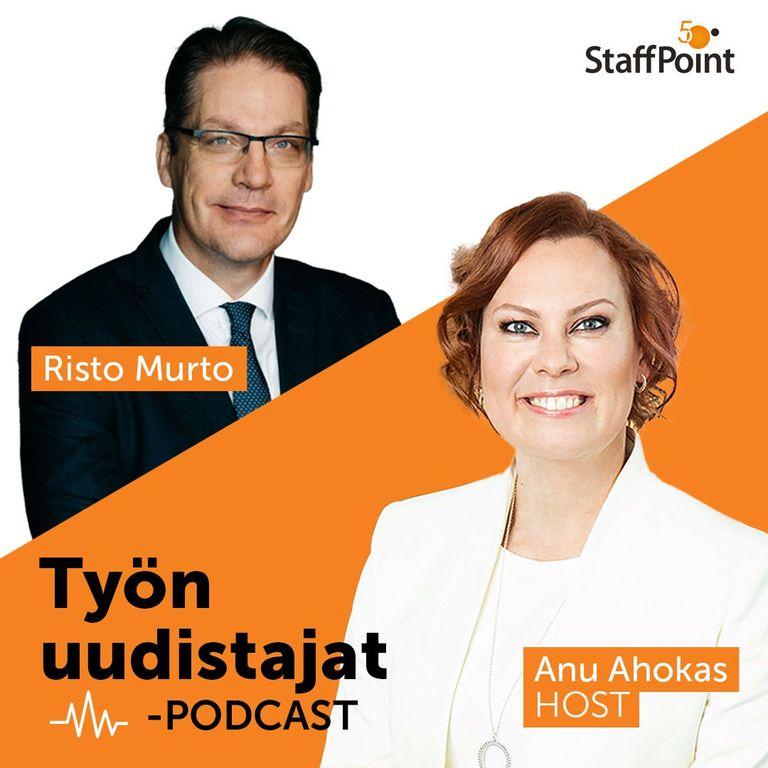
Työn Uudistajata -podcast dives into Finnish working life and its renewal — without ceremonial speeches or political jargon! In the very first episode, the discussion revolves around whether Finland is running out of working-age people and what could be done to solve the issue.
In this episode, host Anu Ahokas is joined by Risto Murto, CEO of Varma Mutual Pension Insurance Company and Doctor of Economics. In October 2022, Murto published his book Puuttuvat puoli miljoonaa (“The Missing Half a Million”), which examines Finland’s future through demographic development.
What does “the missing half a million” mean?
Murto uses the figure as an example to illustrate how many more people Finland would need in the coming decades to achieve the same level of growth as neighboring Sweden. Simply put, Finland needs more hands:
“One challenging demographic shift has already happened when the large post-war generations retired. The effects weren’t immediate but hit us quickly during the last moments of the economic upswing. The labor shortage came very fast,” Murto explains.
The number of working-age people continues to decline. While the annual change isn’t dramatic, it still limits growth, and in some sectors, labor shortages may become chronic. The issue also affects the economy, as the national debt accumulating in Finland will become a long-term burden for future generations.
“If we continue like this, in the coming decades the welfare state will have to scale back its promises, which are typically tied to public debt. This process will likely be painful,” Murto continues.
Currently, Finland is moving in the opposite direction — adding commitments while deficits remain chronic. According to Murto, Finland’s demographic structure increasingly resembles that of Italy rather than the other Nordic countries.
“The Nordic welfare state is our ideal, but our demographic structure doesn’t support it,” Murto summarizes.
Finland’s quiet success story
Murto points out Finland’s quiet success story: the later retirement age. Over the last ten years, the average retirement age has risen by two years, a positive trend that appears to continue.
“We live longer and healthier lives. If living standards and medical care continue to improve, we’ll work longer too. This requires flexibility from working life, in physically demanding jobs, for example, task changes or part-time options. But there’s no reason we couldn’t move toward a retirement age of 70,” Murto says.
He also highlights mental health issues as a growing national concern, especially among young people. While material well-being has improved, psychological well-being hasn’t followed the same trajectory.
“The problem shouldn’t be over-medicalized. We must address the root causes, not solve societal issues by simply adding more therapy,” Murto warns.
The healthcare sector cannot function without immigration
One solution to the demographic challenge is immigration. Although public debate in Finland has been cautious, Murto considers immigration inevitable.
“We can’t run our healthcare or low-wage sectors without immigration. The large generations are aging rapidly, increasing the need for round-the-clock care. If we already face worker shortages in care sectors, what will it look like in five years?” Murto asks.
Successful integration into society is key, especially when people come to Finland for work rather than as refugees. Murto gives an example from Sweden:
“Sweden’s challenge is that the share of refugees among immigrants is the highest in the OECD. Integrating them into the labor market requires great effort. Finland, in fact, seems to be doing even worse when it comes to integrating refugee women into working life.”
If women are not accustomed to participating in the workforce in their home country, integration into Finnish working life is especially difficult. Murto stresses that this issue must not be passed on to the next generation.
“It’s crucial that children receive education and enter the workforce. Language learning is key. Ideally, a refugee-background girl finishing comprehensive school in Finland should continue to study, find employment, and stay in working life,” Murto concludes.Opens in a new tab
You have not approved cookies yet, please provide consent and try again